Table of contents
ToggleIntroduction
In January 2022, Microsoft announced a $69 billion acquisition of Activision Blizzard. It was not just the largest deal in gaming history. It was a defining moment in the race for digital ecosystems.
At first glance, the transaction looked like a bold expansion into the video game industry. But beneath the headline figure lies a much deeper strategic move. This acquisition reflects how Big Tech companies are redefining competition, shifting away from products toward platforms, and from one-time sales toward recurring, subscription-driven models.
For Microsoft, gaming is no longer a side business. It has become a central pillar of its long-term strategy, alongside cloud computing and enterprise software. Over the past decade, the company has progressively built an integrated ecosystem combining hardware with Xbox, digital distribution through its store, and subscription services with Game Pass. By acquiring Activision Blizzard, Microsoft is not simply adding revenue. It is securing control over some of the most valuable intellectual properties in entertainment, from Call of Duty to World of Warcraft, while strengthening its ability to attract and retain users within its ecosystem.
The scale of the deal also highlights a broader transformation within the gaming industry. Once fragmented, the sector is now undergoing rapid consolidation, driven by the growing importance of content ownership, user engagement, and technological infrastructure. In this context, blockbuster franchises are no longer just games. They are strategic assets capable of generating recurring revenue streams and reinforcing platform dominance.
However, the acquisition did not go unchallenged. Regulators across the United States, Europe, and the United Kingdom closely examined the deal, raising concerns about market concentration and the potential impact on competition. The debate extended beyond gaming, touching on fundamental questions about the power of large technology firms and the role of regulation in digital markets.
This article explores the Microsoft–Activision Blizzard deal from a financial and strategic perspective. It will first analyze the foundations of the transaction and the rationale behind it. It will then examine the regulatory battles and competitive tensions that shaped the deal. Finally, it will assess its long-term implications for the gaming industry, Big Tech strategies, and the broader landscape of mergers and acquisitions.
1. Understanding the Deal: Strategic and Financial Foundations
1.1 A Record-Breaking Acquisition
When Microsoft announced its intention to acquire Activision Blizzard in January 2022, the headline figure immediately captured global attention. At $68.7 billion, the transaction became the largest acquisition ever in the video game industry and one of the biggest in the history of the technology sector.
The deal was structured as an all-cash transaction, with Microsoft offering $95 per share to Activision Blizzard shareholders. This represented a significant premium compared to the company’s pre-announcement trading price, reflecting both the strategic value of the target and the competitive dynamics surrounding high-quality gaming assets. The acquisition was ultimately completed in October 2023, after nearly two years of regulatory scrutiny and negotiations across multiple jurisdictions.
To fully grasp the scale of the transaction, it is essential to compare it with previous acquisitions in the gaming industry. While consolidation has been accelerating in recent years, no deal comes close to the magnitude of Microsoft’s acquisition of Activision Blizzard.
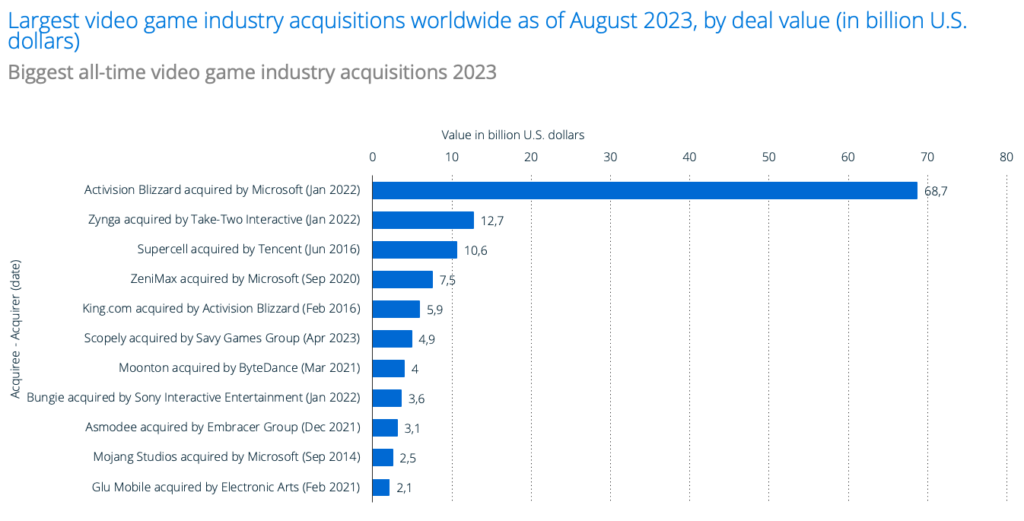
As illustrated above, the gap between this transaction and previous deals is striking. At nearly $69 billion, the acquisition of Activision Blizzard dwarfs other major transactions such as Take-Two’s acquisition of Zynga or Microsoft’s earlier purchase of ZeniMax.
This difference is not merely quantitative. It reflects a structural shift in how the industry values gaming assets. Premium franchises, large user bases, and recurring revenue models are now seen as strategic resources worth unprecedented levels of investment. In this context, Microsoft’s move signals a clear willingness to lead the consolidation wave rather than follow it.
From a financial perspective, the scale of the deal illustrates Microsoft’s ability to deploy capital aggressively. With a strong balance sheet, substantial cash reserves, and consistent cash flow generation from its core businesses such as cloud computing and enterprise software, Microsoft was uniquely positioned to execute such a large transaction without jeopardizing its financial stability.
Beyond its size, the acquisition stands out when compared to previous landmark deals in gaming and tech. Transactions such as Take-Two’s acquisition of Zynga or Microsoft’s earlier purchase of Bethesda appear modest in comparison. This reflects a shift in valuation dynamics, where premium content and engaged user bases command increasingly high prices.
At its core, this was not just a large deal. It was a strategic bet on the future structure of digital entertainment.
1.2 Microsoft’s Strategic Vision in Gaming
To fully understand the rationale behind the acquisition, it is essential to look at the evolution of Microsoft’s gaming strategy. Historically, the company’s presence in gaming was centered around its Xbox consoles, competing directly with rivals like Sony. However, over time, Microsoft has shifted its focus away from hardware-centric competition toward a broader ecosystem approach.
This transformation is best illustrated by the development of Xbox Game Pass, a subscription service that provides users with access to a large library of games for a monthly fee. Often described as the “Netflix of gaming,” this model reflects a broader trend in digital industries, where recurring revenue and user retention are prioritized over one-time purchases.
In this context, content becomes the key driver of value. The more attractive and exclusive the content offering, the stronger the platform’s ability to attract and retain users. By acquiring Activision Blizzard, Microsoft significantly strengthens its content portfolio, gaining control over some of the most popular and profitable franchises in the world.
The deal also aligns with Microsoft’s ambitions in cloud gaming. Through its Azure infrastructure, the company is investing heavily in the ability to stream games directly to users, removing the need for high-end hardware. This positions Microsoft at the intersection of gaming, cloud computing, and subscription services, creating a highly integrated ecosystem.
Ultimately, the acquisition reflects a clear strategic objective: to become a dominant platform in interactive entertainment, leveraging scale, technology, and content to build long-term competitive advantages.
1.3 Activision Blizzard: A Premium Asset
From Microsoft’s perspective, Activision Blizzard represents a uniquely valuable asset. The company is not just a game developer. It is a global entertainment powerhouse with a portfolio of iconic franchises, a massive user base, and strong recurring revenue streams.
Among its most notable assets are Call of Duty, one of the best-selling video game franchises of all time, World of Warcraft, a long-standing leader in the massively multiplayer online genre, and Candy Crush, a dominant player in mobile gaming. These franchises span multiple platforms and demographics, providing diversification and resilience.
Financially, Activision Blizzard has demonstrated strong profitability and cash flow generation. Its business model increasingly relies on in-game purchases, subscriptions, and live services, which provide more predictable and recurring revenues compared to traditional game sales. This aligns closely with Microsoft’s strategic shift toward subscription-based models.
Another key element of Activision Blizzard’s value lies in its user base. With hundreds of millions of active players worldwide, the company offers Microsoft immediate scale and engagement. This is particularly important in a platform-driven strategy, where network effects and user retention are critical success factors.
In addition, the acquisition allows Microsoft to strengthen its position in mobile gaming, a segment where it has historically been less present. Through Activision Blizzard’s mobile division, particularly King, Microsoft gains access to a fast-growing market with significant monetization potential.
In essence, Activision Blizzard is not just a content provider. It is a strategic asset that enhances Microsoft’s ecosystem, accelerates its growth in key segments, and reinforces its long-term positioning in the evolving digital entertainment landscape.
2. Deal Challenges: Regulation, Competition, and Negotiation
2.1 Global Regulatory Scrutiny
If the scale of the acquisition made headlines, the regulatory battle that followed defined the deal. From the moment Microsoft announced its intention to acquire Activision Blizzard, competition authorities around the world moved quickly to assess its implications.
Three major regulators played a central role in the process: the Federal Trade Commission in the United States, the European Commission, and the Competition and Markets Authority in the United Kingdom. Each authority approached the deal through a similar lens, focusing on whether the acquisition could reduce competition and strengthen Microsoft’s market power in key segments.
The concerns were primarily twofold. First, regulators feared that Microsoft could make Activision Blizzard’s flagship franchises, particularly Call of Duty, exclusive to its ecosystem. Such a move could weaken competitors, especially Sony, and distort competition in the console market. Second, authorities raised concerns about the emerging cloud gaming market, where Microsoft already holds a strong position through its Azure infrastructure and Game Pass service.
The review process was long and complex, extending over nearly two years. In the United States, the Federal Trade Commission attempted to block the deal through legal action, arguing that it would harm competition. In Europe, the European Commission ultimately approved the acquisition, but only after Microsoft agreed to a series of commitments aimed at preserving competition in cloud gaming. The most significant resistance came from the UK’s Competition and Markets Authority, which initially blocked the deal over concerns related to cloud gaming dominance before eventually approving a restructured version of the transaction.
This intense scrutiny reflects a broader shift in regulatory attitudes toward Big Tech. Large acquisitions are no longer assessed solely on current market shares, but also on their potential to shape future industries.
2.2 The Battle Over Competition
Beyond regulatory institutions, the acquisition triggered a high-profile competitive battle, most notably between Microsoft and Sony. At the heart of this conflict was a single question: who controls access to the most valuable gaming content?
Sony, whose PlayStation platform dominates the console market, strongly opposed the deal. Its argument was clear. If Microsoft were to gain control over franchises like Call of Duty, it could either make them exclusive to Xbox or degrade their quality on competing platforms. Even the mere possibility of such a scenario was seen as a significant competitive threat.
Microsoft, on the other hand, consistently argued that exclusivity would not be in its economic interest. The company emphasized that keeping major franchises available across platforms would maximize revenue and player engagement. More importantly, Microsoft framed the deal as a way to increase competition against larger players in gaming, including mobile giants and other tech companies.
This debate highlighted a deeper transformation within the industry. Competition is no longer limited to consoles. It increasingly revolves around ecosystems, where content, distribution, and infrastructure are tightly integrated. In this context, owning high-quality intellectual property becomes a decisive advantage.
Another critical dimension of the competition debate was cloud gaming. Still in its early stages, this segment is widely seen as the future of the industry. By enabling users to stream games directly without requiring powerful hardware, cloud gaming could significantly lower barriers to entry and reshape competitive dynamics. Regulators feared that Microsoft, by combining its cloud infrastructure with exclusive content, could gain a dominant position in this emerging market.
A central element of the regulatory debate was not the current state of the gaming market, but its future evolution. Cloud gaming, still in its early stages, is widely expected to become a major growth driver for the industry.
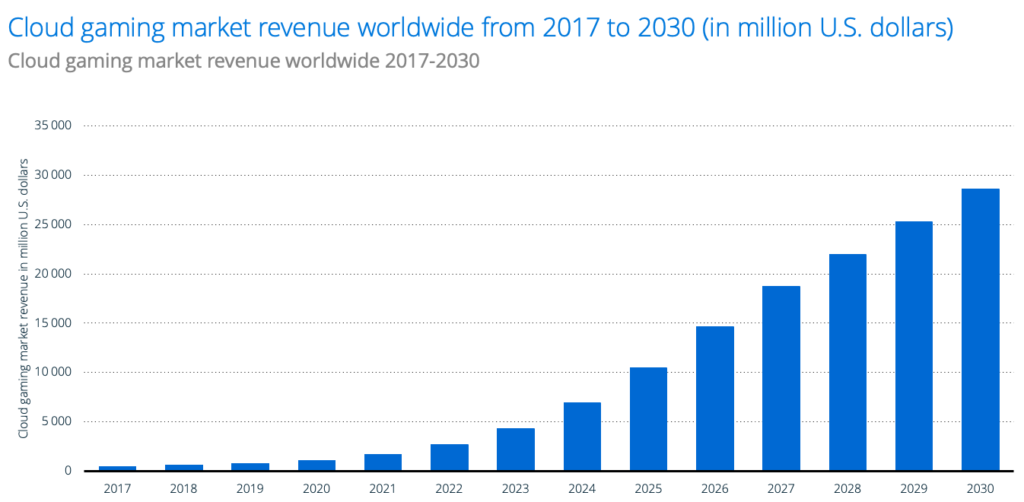
The projected growth of the cloud gaming market highlights why regulators paid such close attention to this segment. Revenues are expected to increase exponentially over the coming decade, transforming cloud gaming into a multi-billion-dollar industry.
In this context, Microsoft’s positioning raises strategic concerns. By combining its Azure cloud infrastructure with a vast portfolio of premium content, the company could gain a significant first-mover advantage. This explains why authorities, particularly in the United Kingdom, focused heavily on cloud gaming when assessing the competitive impact of the deal.
More broadly, this growth trajectory reinforces the idea that the acquisition of Activision Blizzard is not just about current market share, but about controlling the future of game distribution.
Ultimately, the battle over competition was not just about the present state of the gaming industry. It was about who would shape its future.
2.3 Negotiation Dynamics and Concessions
To secure regulatory approval and complete the acquisition, Microsoft had to engage in extensive negotiations and make significant concessions. These commitments played a crucial role in addressing concerns and reshaping the structure of the deal.
One of the most important concessions involved long-term licensing agreements. Microsoft committed to keeping key franchises, including Call of Duty, available on competing platforms for at least ten years. Agreements were signed with several industry players, ensuring that the content would remain accessible beyond the Xbox ecosystem. These commitments were designed to reassure both regulators and competitors that Microsoft would not use its new assets to restrict competition.
In the European Union, Microsoft agreed to allow cloud gaming providers to license Activision Blizzard games, enabling them to offer these titles on their own platforms. This was a direct response to concerns about the potential dominance of Microsoft in cloud gaming. By opening access to its content, Microsoft aimed to demonstrate that the acquisition would not lead to market foreclosure.
The situation in the United Kingdom required an even more structural solution. To address the Competition and Markets Authority’s concerns, Microsoft restructured the deal by transferring cloud streaming rights for Activision Blizzard games to a third party, Ubisoft, outside the European Economic Area. This innovative approach allowed regulators to approve the transaction while maintaining competitive balance in the cloud gaming market.
These negotiations highlight an important lesson in modern M&A. Large cross-border deals are no longer purely financial or strategic exercises. They are also political and regulatory processes that require flexibility, communication, and compromise.
In the end, Microsoft’s ability to adapt its strategy, engage with stakeholders, and offer credible remedies was decisive. The acquisition of Activision Blizzard was not only a test of financial strength, but also of regulatory navigation and strategic negotiation.
3. Implications for the Future of Tech, Gaming, and Finance
3.1 A New Era of Consolidation in Gaming
The acquisition of Activision Blizzard by Microsoft is not an isolated event. It is part of a broader wave of consolidation reshaping the global gaming industry. Over the past decade, the sector has evolved from a fragmented landscape of studios and publishers into a highly competitive arena dominated by a few large players with global reach.
This trend is driven by several structural factors. First, the cost of developing high-quality games has increased significantly, often reaching hundreds of millions of dollars for blockbuster titles. Second, user expectations have shifted toward continuous content updates, live services, and immersive experiences. Finally, distribution has become increasingly digital, favoring companies that control platforms and ecosystems.
In this environment, scale matters more than ever. Large publishers and technology companies are seeking to acquire studios, intellectual property, and user communities to strengthen their competitive position. The Microsoft–Activision Blizzard deal sets a new benchmark in terms of valuation and ambition, signaling that premium gaming assets are now considered strategic investments rather than optional expansions.
As a result, further consolidation appears likely. Other major players, including platform owners and tech companies, may pursue acquisitions to avoid being left behind. For investors and analysts, this suggests a sustained pipeline of M&A activity in the gaming and entertainment sectors, with valuations remaining elevated for companies that own strong franchises and engaged audiences.
3.2 The Rise of Subscription and Cloud Gaming
One of the most significant implications of the deal lies in the transformation of gaming business models. With its acquisition of Activision Blizzard, Microsoft is accelerating a shift toward subscription-based and cloud-driven gaming.
Traditionally, the industry relied heavily on one-time game purchases, often tied to specific hardware. Today, this model is gradually being replaced by recurring revenue streams through subscriptions, in-game purchases, and digital services. Xbox Game Pass is at the center of this transformation, offering users access to a vast library of games for a monthly fee.
The integration of Activision Blizzard’s content into this ecosystem has the potential to significantly increase the attractiveness of the service. High-profile franchises can act as powerful acquisition and retention tools, reinforcing the value proposition of subscription platforms.
At the same time, cloud gaming is emerging as a key technological driver. By leveraging its Azure infrastructure, Microsoft aims to enable users to access games instantly across devices, without the need for expensive hardware. This could lower barriers to entry, expand the global gaming audience, and fundamentally change how games are consumed.
However, this transformation also raises important questions. Will subscription models lead to greater accessibility, or will they concentrate power in the hands of a few dominant platforms? Will cloud gaming democratize access, or create new forms of dependency on large technology providers? These uncertainties highlight the strategic importance of the current transition phase.
3.3 Broader Lessons for Finance and Big Tech Strategy
Beyond the gaming industry, the Microsoft–Activision Blizzard deal offers valuable insights into modern corporate finance and strategic decision-making. At its core, the transaction illustrates how companies are increasingly investing in intangible assets such as intellectual property, user ecosystems, and data.
Unlike traditional industries, where value is often tied to physical assets, digital businesses derive a significant portion of their worth from their ability to attract and retain users. In this context, franchises like Call of Duty or platforms with millions of active users become critical drivers of long-term cash flow. This justifies high valuation multiples and aggressive acquisition strategies.
The deal also highlights the growing importance of M&A as a strategic tool. For Microsoft, acquiring Activision Blizzard was faster and more effective than building similar capabilities organically. This reflects a broader trend among large corporations, which increasingly rely on acquisitions to accelerate growth, enter new markets, and secure competitive advantages.
At the same time, the transaction underscores the central role of regulation in shaping corporate strategy. As seen throughout the approval process, regulatory risk has become a key factor in deal execution. Companies must now anticipate potential objections, engage with multiple stakeholders, and design transactions that can withstand intense scrutiny.
For finance professionals, this implies a more complex deal-making environment. Valuation is no longer sufficient. Understanding regulatory frameworks, competitive dynamics, and long-term strategic positioning is essential to successfully analyze and execute large-scale transactions.
Ultimately, the Microsoft–Activision Blizzard deal reflects a new reality. In a world where technology, content, and distribution are increasingly interconnected, the boundaries between industries are blurring. Companies that can combine these elements into cohesive ecosystems will be best positioned to capture value in the years ahead.
Conclusion
The acquisition of Activision Blizzard by Microsoft stands as one of the most significant transactions in the history of the technology and entertainment industries. Far beyond its $69 billion price tag, the deal reflects a profound transformation in how value is created, captured, and sustained in the digital economy.
At its core, this acquisition is about control over ecosystems. By integrating one of the most powerful portfolios of gaming franchises into its broader platform, Microsoft is strengthening its ability to attract, engage, and retain users across multiple touchpoints. Gaming is no longer an isolated vertical. It is becoming a central component of a larger strategy that connects cloud infrastructure, subscription models, and digital distribution.
The deal also highlights the increasing importance of intangible assets. Intellectual property, user communities, and engagement metrics are now at the heart of valuation and strategic decision-making. For finance professionals, this shift requires a deeper understanding of how these elements translate into long-term cash flows and competitive advantages.
At the same time, the challenges encountered throughout the process illustrate a new reality for large-scale M&A. Regulatory scrutiny is intensifying, particularly when transactions involve major technology players with the potential to shape emerging markets. The Microsoft–Activision Blizzard case demonstrates that executing such deals is no longer শুধু a matter of financial capacity or strategic rationale. It also requires the ability to navigate complex regulatory landscapes and address concerns related to competition and market power.
Looking ahead, several key questions remain. Will Microsoft succeed in establishing a dominant position in subscription and cloud gaming? How will competitors respond in an increasingly consolidated industry? And perhaps most importantly, how will regulators adapt to a world where technological innovation continuously reshapes market boundaries?
What is certain is that this deal marks a turning point. It signals the acceleration of consolidation in gaming, the rise of new business models, and the growing convergence between technology, media, and finance. For investors, executives, and students of finance alike, it offers a compelling case study of how strategy, valuation, and regulation intersect in today’s global economy.
In the end, the Microsoft–Activision Blizzard acquisition is not just a story about gaming. It is a story about the future of digital industries, where scale, content, and ecosystems define success.