
Table of contents
ToggleIntroduction
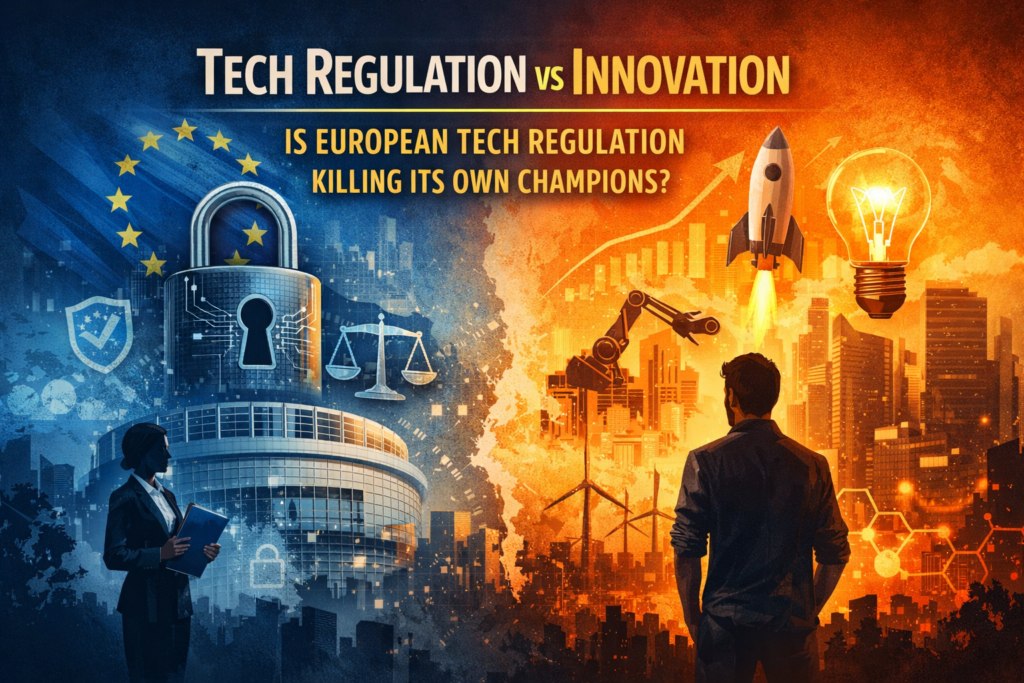
Europe regulates technology like a global superpower, yet innovates like a middle power. While the United States produces trillion dollar tech giants and China mobilizes state backed digital strategies at scale, Europe has become the world’s most influential rule maker in the tech economy. From data protection to competition policy and artificial intelligence, European regulations increasingly shape global standards. But when it comes to creating global tech champions, Europe consistently falls behind.
This paradox fuels a growing controversy. Critics argue that Europe’s dense regulatory framework discourages risk taking, slows innovation and pushes startups to scale elsewhere. Supporters counter that regulation is a strategic choice, designed to protect citizens, ensure fair competition and build long term digital trust in an increasingly concentrated and opaque tech landscape.
The debate reached a new level with the publication of a competitiveness report led by Mario Draghi, which delivered a blunt diagnosis. Europe, he warned, regulates at continental scale but invests and executes at fragmented national levels. Regulation, in this context, often substitutes for capital, market integration and industrial ambition rather than complementing them.
This article explores whether Europe’s regulatory model is truly killing innovation or whether regulation has become a convenient scapegoat for deeper structural weaknesses. By examining regulation, capital, market scale and strategic coordination, it asks a more fundamental question: can Europe transform regulation from a constraint into a competitive advantage, or will it remain a rule maker in a tech world dominated by others?
I. Europe’s Regulatory Model Under the Microscope
1.1 The Logic of European Tech Regulation
European technology regulation is not accidental, nor purely technocratic. It reflects a deeply rooted political and cultural philosophy that places protection, fairness and stability above speed and disruption. Unlike the United States, where innovation has historically been allowed to run ahead of regulation, or China, where the state actively directs and supports strategic technologies, Europe has chosen a precautionary path. Rules are designed to anticipate risks rather than react to them.
This approach is shaped by Europe’s history. The continent’s regulatory culture was forged through decades of market integration, consumer protection and competition policy aimed at preventing concentration of power. In the digital era, these instincts naturally translated into a strong focus on data privacy, platform dominance and social responsibility. Technology, from a European policymaker’s perspective, is not just an engine of growth. It is also a source of systemic risk that must be constrained before it reshapes society in irreversible ways.
Another key driver is political legitimacy. European institutions often lack the fiscal and industrial firepower of sovereign states, but they possess regulatory authority over a vast single market. Regulation has therefore become Europe’s primary tool of influence in the global digital economy. By setting strict rules for access to its market, Europe effectively exports its standards beyond its borders. For global tech companies, complying with European regulation is not optional.
However, this philosophy carries an implicit trade-off. When protection becomes the dominant objective, innovation is rarely the first-order priority. European regulation is often designed to correct market failures created by foreign tech giants rather than to accelerate the emergence of domestic ones. This defensive posture shapes both the content and the timing of regulatory intervention.
The Digital Markets Act illustrates this shift toward ex ante intervention, aiming to constrain the behavior of dominant platforms before abuses occur, a logic clearly outlined in a recent World Economic Forum analysis of the EU’s new digital rulebook.
1.2 A Dense and Expanding Regulatory Stack
Over the past decade, Europe has built one of the most comprehensive digital regulatory frameworks in the world. The General Data Protection Regulation established strict rules on data collection, processing and consent, fundamentally altering the economics of data driven business models. While GDPR strengthened consumer rights and trust, it also imposed significant compliance costs, particularly for smaller firms without dedicated legal and compliance teams.
The regulatory expansion did not stop there. The Digital Markets Act and the Digital Services Act introduced ex ante obligations for large online platforms, targeting issues such as self-preferencing, gatekeeping and content moderation. These rules aim to preserve competition and protect users, but they also reshape platform economics by limiting monetization strategies and operational flexibility.
More recently, the Artificial Intelligence Act marked a new step in Europe’s regulatory ambition. Rather than regulating AI ex post through existing liability and consumer laws, Europe chose to define risk categories and compliance requirements before many applications reached full market maturity. High risk systems face strict obligations related to transparency, data governance and human oversight.
This regulatory dilemma is particularly visible in artificial intelligence, where innovation is moving faster than governance frameworks, as explored in our in-depth analysis What Are AI Agents and Why Everyone’s Talking About Them?
The cumulative effect is a dense regulatory stack that applies across the entire digital value chain. Each individual regulation may be defensible on its own terms. Taken together, however, they create a complex compliance environment that disproportionately affects startups and scaleups. Large incumbents can amortize regulatory costs across global revenues. Young European firms, by contrast, must divert scarce resources away from product development and market expansion toward legal compliance at an early stage of their growth.
This asymmetry fuels a recurring criticism. Regulation designed to curb the power of dominant platforms may, paradoxically, entrench them by raising barriers to entry for new challengers. The regulatory burden becomes a fixed cost that only the largest players can comfortably absorb.
1.3 What the Draghi Report Reveals About Regulation
The debate over regulation versus innovation gained renewed urgency with the publication of a competitiveness report led by Mario Draghi. Rather than calling for deregulation as a blanket solution, the report delivers a more nuanced diagnosis. Regulation, Draghi argues, becomes a constraint when it is not embedded within a coherent strategy for scale, investment and productivity growth.
One of the report’s most striking observations is that Europe behaves like a regulatory superpower but an economic middleweight. Rules are set at continental scale, yet capital markets remain fragmented, industrial policy is underpowered and innovation financing is insufficient. In this context, regulation often fills a vacuum left by the absence of decisive investment and coordination.
The Draghi analysis highlights a critical imbalance. Europe regulates technology with global ambition, but supports it with national level resources and risk appetite. This mismatch creates friction. Firms are subject to continent wide obligations while operating in fragmented markets that limit their ability to grow quickly and efficiently. Regulation, in this sense, is not the root cause of Europe’s innovation gap, but it amplifies existing weaknesses.
Crucially, the report warns against the illusion that rules alone can shape competitive outcomes. Without deep capital pools, integrated markets and a credible path to scale, regulation risks becoming an end in itself rather than a means to strengthen Europe’s technological position. When compliance costs rise faster than growth opportunities, the rational response for many entrepreneurs is to sell early, relocate or avoid certain sectors altogether.
The Draghi report does not advocate abandoning Europe’s regulatory values. Instead, it calls for alignment. Regulation must be accompanied by investment, simplification and strategic focus. Otherwise, Europe risks locking itself into a model where it governs innovation more effectively than it generates it.
Taken together, Europe’s regulatory model reveals both its strength and its fragility. It reflects a coherent vision of technology serving society, not the other way around. But under current conditions, it also exposes a structural tension between protection and competitiveness. To understand whether regulation is truly the main obstacle to European tech champions, it is necessary to look beyond rules themselves and examine the deeper economic foundations on which innovation depends. This is where the next part of the analysis begins.
II. The Real Innovation Bottlenecks: Beyond Regulation
2.1 Capital Markets and the Scale-Up Gap
If regulation were the primary obstacle to European innovation, one would expect capital to flow freely toward compliant, high-potential firms once rules are understood. In reality, Europe’s most persistent weakness lies elsewhere: the chronic inability to finance growth at scale. Early-stage innovation is not Europe’s main problem. The continent produces a steady stream of high-quality startups, particularly in deep tech, fintech, health tech and AI. The real bottleneck appears at the scale-up phase.
Compared to the United States, European venture capital remains smaller, more fragmented and less willing to fund aggressive expansion. Late-stage financing rounds are rarer, smaller and often led by non-European investors. As a result, many of Europe’s most promising startups face a strategic dilemma. Either they sell early to foreign incumbents, relocate to access deeper capital pools, or accept slower growth trajectories that leave them vulnerable to global competitors.
This funding gap is structural. European institutional investors, including pension funds and insurance companies, allocate a far smaller share of assets to venture capital than their US counterparts. Regulatory constraints, conservative mandates and cultural risk aversion all play a role. Capital exists in Europe, but it is poorly channeled toward high-growth, high-risk innovation.
The Draghi competitiveness report underscores this imbalance. Europe, it argues, does not suffer from a lack of savings but from a failure to transform savings into productive investment. In the tech sector, this failure is particularly visible. Without patient, large-scale capital, even the most innovative firms struggle to become global champions.
2.2 Market Fragmentation and the Illusion of Scale
Europe often presents itself as a single market of more than 400 million consumers. For digital companies in theory, this should be a formidable advantage. In practice, the European market remains fragmented along legal, fiscal, linguistic and administrative lines. Scaling across borders is costly, slow and uncertain.
Startups expanding from one European country to another face different tax regimes, labor laws, consumer protection rules and enforcement practices. Even when regulations are harmonized at the EU level, national interpretations and bureaucratic processes vary widely. What works in Germany may require significant adaptation in Italy or Spain. This fragmentation erodes the speed advantage that is critical in technology markets.
By contrast, US startups benefit from a genuinely unified domestic market. A company that succeeds in California can scale nationally with relatively limited friction. Network effects, brand recognition and operational efficiency compound quickly. European firms rarely enjoy this dynamic. Growth is incremental rather than exponential.
Regulation interacts with fragmentation in subtle ways. EU level rules impose uniform obligations, but the economic upside of a unified market often fails to materialize. Firms bear continental compliance costs while capturing only partial scale benefits. This asymmetry reinforces the perception that regulation is burdensome, even when the deeper issue is market integration rather than rulemaking itself.
2.3 Talent, Productivity and Commercialization Failures
Europe’s innovation challenge is not rooted in a lack of talent or research excellence. European universities and research institutions consistently rank among the world’s best. Public funding for basic research is strong, and scientific output remains competitive. The problem emerges at the interface between research, entrepreneurship and industry.
Technology transfer mechanisms are often weak. Academic breakthroughs struggle to find commercial pathways. Spin-offs are underfunded, poorly incentivized or disconnected from industrial partners. In the United States, close ties between universities, venture capital and corporate ecosystems accelerate commercialization. In Europe, these links remain uneven and underdeveloped.
Talent mobility presents another constraint. High-skilled workers face immigration barriers, rigid labor markets and limited stock-based compensation frameworks compared to US tech hubs. As a result, Europe experiences a steady brain drain of engineers, founders and researchers toward ecosystems where risk-taking is rewarded more aggressively and upside potential is clearer.
Productivity trends reinforce these concerns. Over the past two decades, Europe’s productivity growth has lagged behind that of the United States, particularly in technology intensive sectors. Innovation exists, but it diffuses slowly through the economy. Digital adoption among small and medium-sized enterprises remains uneven, limiting the broader impact of technological progress.
Once again, regulation plays a secondary role. Rules may shape incentives at the margin, but they do not explain why European research so often fails to translate into global commercial success. The bottleneck lies in coordination, incentives and execution rather than in legal constraint alone.
III. Regulation as Strategy: Can Europe Turn Constraints into Strengths?
3.1 From Defensive Regulation to Competitive Advantage
Europe’s regulatory ambition is often framed as a handicap. Yet under the right conditions, regulation can become a strategic asset rather than a constraint. In a global digital economy increasingly shaped by concerns over privacy, security, market concentration and algorithmic power, trust has emerged as a scarce and valuable commodity. Europe is uniquely positioned to supply it.
By imposing strict standards on data protection, transparency and accountability, Europe has effectively created a quality label for digital products and services. Compliance with European rules signals reliability and legal robustness, particularly for corporate clients, regulated industries and public institutions. In areas such as financial services, health tech and enterprise software, this credibility can translate into commercial advantage.
The global diffusion of European standards reinforces this dynamic. Many non-European firms voluntarily adopt EU compliant practices to avoid operating fragmented systems across regions. In doing so, Europe exports its regulatory model beyond its borders. This phenomenon has already been observed with data protection and is beginning to emerge in artificial intelligence governance.
However, for regulation to function as a moat rather than a barrier, European firms must be able to capitalize on it. Trust only becomes a competitive edge if companies can scale globally, invest aggressively and innovate within the regulatory framework. Without scale, regulation risks benefiting foreign incumbents more than domestic challengers.
3.2 Aligning Regulation, Capital and Industrial Policy
The central insight of the competitiveness debate is that regulation cannot operate in isolation. The report led by Mario Draghi makes this point explicitly. Rules that shape market behavior must be matched by capital, infrastructure and strategic coordination. Otherwise, regulation substitutes for power rather than reinforcing it.
Turning regulation into strategy requires three concrete shifts. First, regulatory simplification. This does not mean abandoning standards, but reducing overlap, accelerating approval processes and improving legal predictability. Complex and slow enforcement undermines innovation even when rules are well intentioned.
Second, Europe must complement regulation with scale oriented investment. Strategic technologies such as AI infrastructure, semiconductors, cloud computing and cybersecurity require capital intensity that exceeds the capacity of fragmented national programs. Public funding should crowd in private capital, not replace it, and be deployed with a clear focus on scale and global competitiveness.
Third, experimentation must be institutionalized. Regulatory sandboxes and controlled testing environments allow firms to innovate within clear boundaries while giving regulators real world feedback. When regulation evolves alongside technology rather than ahead of it, uncertainty declines and incentives improve.
Without these adjustments, regulation risks locking Europe into a static equilibrium. Values are protected, but ambition is constrained. Alignment, not rollback, is the lever that determines whether regulation strengthens or weakens Europe’s tech ecosystem.
3.3. The Future of European Tech Champions
The emergence of European tech champions will not hinge on deregulation alone. It will depend on whether Europe can reconcile its normative power with economic execution. Champions require scale, speed and sustained risk-taking. They also require predictable rules and institutional trust. Europe already excels at the latter. The challenge is to deliver the former.
This implies difficult trade-offs. Europe may need to accept higher short-term risk in pursuit of long-term competitiveness. It may need to tolerate market concentration in strategic sectors while preserving contestability. It may also need to rethink how success is measured, shifting focus from regulatory leadership alone to value creation and global presence.
Crucially, the objective should not be to replicate the American or Chinese models. Europe’s comparative advantage lies in its ability to combine innovation with legitimacy, openness with protection and competition with social stability. A distinct European tech model is possible, but only if regulation is embedded within a broader growth strategy rather than standing in for it.
The core question posed by this article can now be answered with greater clarity. Europe is not killing its own champions through regulation. But neither is it creating the conditions for them to thrive at scale. Regulation, in its current form, reflects Europe’s values more than its ambitions.
Whether Europe remains primarily a rule maker or becomes a global technology leader will depend on its ability to transform regulation from a defensive reflex into an offensive strategy. The window for that transformation is narrowing. In a world defined by technological acceleration and geopolitical competition, values without scale risk becoming constraints rather than strengths.
Conclusion
The idea that Europe is killing its own tech champions through regulation is both tempting and incomplete. Europe’s rules reflect deliberate choices about privacy, competition and accountability, not a rejection of innovation. Regulation has not prevented Europe from producing talent or ideas, but it has exposed deeper weaknesses in how innovation is financed, scaled and commercialized.
As highlighted by Mario Draghi, Europe regulates at continental scale while capital markets, investment capacity and execution remain fragmented. In this context, regulation amplifies existing bottlenecks rather than creating them. The real challenge lies in the absence of deep capital pools, integrated markets and a coherent strategy to support growth in strategic technologies.
Europe’s future will not be decided by deregulation alone. It will depend on whether regulation is aligned with investment, simplification and ambition. If Europe succeeds, regulation can become a source of trust and competitive strength. If it fails, Europe risks remaining a global rule maker in an economy shaped by technologies it did not build.