Table of contents
ToggleIntroduction
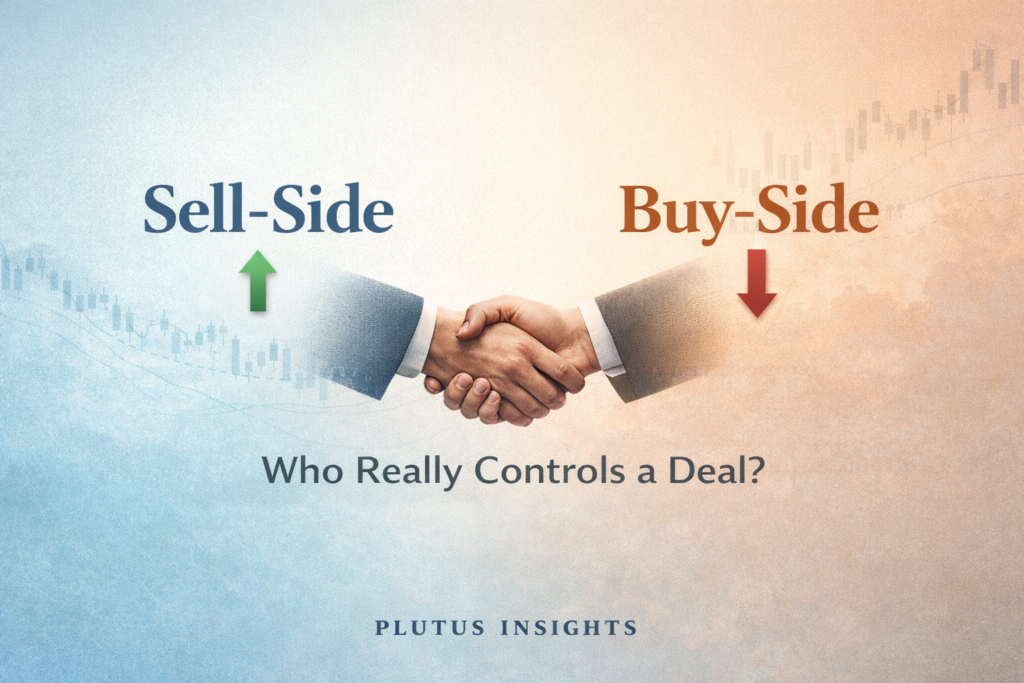
Sell-side vs buy-side sounds like a clear opposition. In reality, it is a constant negotiation where power changes hands multiple times. In finance, deals are often presented as carefully choreographed transactions where roles are clearly defined. The sell-side advises, structures and executes. The buy-side analyzes, negotiates and invests. At first glance, the balance of power seems obvious. One side brings the opportunity to market. The other brings the capital. Yet anyone who has observed a real transaction from the inside knows that control is far more elusive than it appears.
The question of who really controls a deal sits at the heart of modern financial markets. It matters for pricing, timing, risk allocation and ultimately value creation. It also matters for students and young professionals trying to understand where influence truly lies in investment banking, asset management or private equity. Titles and formal roles rarely tell the full story. Power shifts quietly as information changes hands, as market conditions evolve and as conviction is tested under pressure.
On paper, the sell-side appears dominant. Investment banks originate transactions, craft valuation narratives, select comparables and manage access to opportunities. They control the process, the calendar and often the first version of the story. In buoyant markets, this influence can feel overwhelming, with capital chasing deals that are carefully packaged and aggressively marketed.
But the buy-side operates under a different logic. Capital is finite, opportunity cost is real and every investment must survive internal scrutiny. Behind closed doors, models are rebuilt, assumptions challenged and scenarios stress-tested. A single investment committee decision can halt months of sell-side work. In moments of uncertainty or capital scarcity, the power dynamic can reverse abruptly.
This article explores that tension in depth. Rather than framing the sell-side and buy-side as fixed positions of strength or weakness, it treats control as a dynamic concept that evolves throughout a deal’s lifecycle. From origination and structuring to due diligence, pricing and execution, influence moves back and forth depending on information, leverage and market context.
Ultimately, understanding who controls a deal is less about choosing a side and more about understanding when, how and why power shifts. That is where the real mechanics of finance are revealed.
I. Understanding the Two Sides of the Market
Before asking who controls a deal, it is essential to clearly understand who the players are and how they operate. The sell-side and the buy-side are often presented as two opposing camps, yet they are deeply interdependent. Each side follows its own economic logic, incentives and constraints, and these differences largely explain why control in financial transactions is never absolute.
While the distinction between sell-side and buy-side is widely used in finance, its implications are often oversimplified. As outlined by Investopedia, the two sides operate under fundamentally different incentive structures, which shapes how they approach risk, pricing and execution.
1.1 What Is the Sell-Side? Roles, Incentives and Business Model
The sell-side refers to financial institutions whose primary role is to create, structure and distribute financial products or transactions to investors. In practice, this side of the market is dominated by investment banks and broker-dealers, supported by sales and trading desks, research teams and advisory units.
At its core, the sell-side acts as an intermediary. It connects companies seeking capital or strategic transactions with investors willing to deploy funds. In public markets, this includes underwriting equity and debt issuances, making markets in securities and producing research that supports trading activity. In private markets, it involves advising on mergers and acquisitions, divestitures and capital raises.
The sell-side business model is largely fee-driven. Revenues are generated through advisory fees, underwriting fees, trading commissions and, in some cases, balance sheet usage. This creates a strong incentive to maximize transaction volume and ensure deals are completed. A closed deal generates revenue. A stalled or abandoned one does not.
This incentive structure shapes sell-side behavior in several ways:
- A strong focus on deal origination and pitching, often well before a transaction is publicly visible
- Narrative construction through valuation frameworks, strategic rationales and market positioning
- Tight control over process design, including timelines, data room access and communication flows
Because the sell-side interacts with multiple buyers across different transactions, it accumulates broad market knowledge. It sees pricing trends, investor appetite and shifting sector dynamics in real time. This informational advantage allows it to guide issuers on when to come to market and how to present a deal in the most attractive light.
However, this same structure also creates potential conflicts. Research is meant to inform investors, yet it often sits within institutions that benefit from deal flow. Advisory teams aim to maximize value for their client, but that value is only realized if the transaction actually closes. The sell-side therefore walks a constant line between objective analysis and commercial pressure.
1.2 What Is the Buy-Side? Capital, Strategy and Long-Term Objectives
The buy-side represents institutions that deploy capital with the objective of generating returns over time. Unlike the sell-side, which facilitates transactions, the buy-side makes the investment decisions that ultimately determine whether a deal succeeds or fails.
This group includes asset managers, hedge funds, private equity firms, pension funds, insurance companies and sovereign wealth funds. Despite their differences in strategy and time horizon, they share a common feature: they are stewards of capital, often on behalf of third parties.
The buy-side business model is performance-driven. Revenues come from management fees, performance fees or long-term mandates that depend on consistent results. This creates a fundamentally different incentive structure from that of the sell-side. While the sell-side benefits from execution, the buy-side bears the economic consequences of the investment long after the deal is closed.
As a result, buy-side decision-making is typically characterized by:
- A strong emphasis on fundamental analysis and downside risk
- Internal validation through investment committees and risk teams
- A focus on long-term value creation rather than transaction momentum
Buy-side firms also operate under strict constraints. Capital is finite and must be allocated across competing opportunities. Every investment implies an opportunity cost. In addition, regulatory, fiduciary and reputational considerations impose discipline on how and where capital can be deployed.
Information access is another key difference. The buy-side rarely controls the initial narrative. It reacts to opportunities brought to market by the sell-side or sourced through proprietary networks. To compensate, buy-side teams rebuild valuations from scratch, challenge assumptions and seek alternative data points to reduce informational asymmetry.
In private markets, particularly in private equity, the buy-side may exert more direct operational influence post-acquisition. However, even in these cases, entry price and deal structure largely determine future returns. This makes the negotiation phase a critical moment where buy-side leverage can be decisive.
1.3 Why the Sell-Side vs Buy-Side Distinction Matters
The distinction between sell-side and buy-side is not merely semantic. It reflects two fundamentally different relationships to risk, time and information. These differences explain why control in financial deals shifts rather than remaining fixed.
The sell-side operates in a transactional logic. Its success is measured by deal flow, execution quality and client relationships. Control manifests through process management, access to opportunities and the ability to frame a transaction attractively. In many cases, the sell-side sets the initial conditions under which a deal unfolds.
The buy-side, by contrast, operates in an allocation logic. Its power lies in selectivity. The ability to say no, delay a decision or demand better terms is often more influential than formal control over the process. When capital is scarce or uncertainty rises, this leverage becomes particularly visible.
Understanding this distinction is essential for interpreting real-world deal dynamics. Apparent dominance at one stage of a transaction may conceal vulnerability at another. A deal that looks fully controlled by the sell-side during marketing can quickly shift in favor of the buy-side during due diligence or pricing negotiations.
Ultimately, the sell-side vs buy-side divide is best understood not as a battle for permanent control, but as a framework for analyzing how influence moves throughout a transaction. This perspective sets the foundation for examining how power evolves across the deal lifecycle, which is where control is truly tested.
II. Control Across the Deal Lifecycle
Control in financial transactions is rarely static. It evolves as a deal moves from an idea to a signed agreement and, in some cases, to a failed process. Each phase of the deal lifecycle favors different skills, resources and forms of leverage. Understanding where control sits at each stage is essential to understanding how transactions are actually shaped.
2.1 Origination and Deal Structuring: The Sell-Side’s Playground
The earliest stage of a deal is where the sell-side typically holds the greatest influence. Origination begins long before any formal process is launched. Investment banks spend months, sometimes years, cultivating relationships, developing strategic ideas and positioning themselves as trusted advisors to corporate executives or shareholders.
At this stage, control stems from initiative and access. The sell-side identifies opportunities, whether a potential acquisition, divestiture, IPO or capital raise, and frames them as timely and value-enhancing. By doing so, it shapes not only the decision to transact but also the initial logic of the deal.
Structuring is a critical component of this influence. The sell-side designs the transaction framework, including:
- The perimeter of assets included in the deal
- The choice between public and private processes
- The proposed valuation approach and reference metrics
- The sequencing of steps and the overall timeline
These choices are not neutral. Valuation multiples, comparable companies and precedent transactions can be selected in ways that support a desired outcome. Strategic narratives are built to emphasize growth, synergies or scarcity, depending on market conditions and investor appetite.
Timing is another powerful lever. Bringing a deal to market during periods of strong liquidity or favorable sentiment can materially affect pricing and demand. Because the sell-side operates across multiple clients and sectors, it often has superior visibility on these windows of opportunity.
In this phase, the buy-side plays a largely reactive role. Investors receive teasers, attend management presentations and begin preliminary analysis, but the structure and story of the deal have already been defined. Control is therefore asymmetric, with the sell-side setting the rules of engagement.
2.2 Due Diligence and Pricing: When the Buy-Side Pushes Back
As a deal progresses into due diligence, the balance of power begins to shift. This phase marks the transition from narrative to verification. Assumptions are tested, numbers are scrutinized and risks that were previously abstract become concrete.
For the buy-side, due diligence is where real influence emerges. Access to data rooms, management teams and third-party advisors allows investors to build independent views of value. Financial models are reconstructed line by line. Sensitivity analyses expose how fragile or resilient the investment case truly is.
Pricing is inseparable from this process. While the sell-side may anchor expectations early, the buy-side ultimately decides whether those expectations are acceptable. Investment committees act as internal gatekeepers, often imposing stricter criteria than those presented in marketing materials.
Several factors enhance buy-side leverage at this stage:
- The ability to walk away without immediate revenue loss
- Competition or lack thereof among potential buyers
- The credibility of downside scenarios identified during diligence
In private transactions, this leverage is particularly visible. Buyers may request price adjustments, earn-outs, warranties or changes in deal structure to compensate for identified risks. Even in public markets, feedback during bookbuilding can force issuers and banks to revise pricing ranges or deal sizes.
The sell-side remains influential, especially in managing information flow and coordinating responses. However, its control is no longer unilateral. The success of the deal increasingly depends on whether buy-side concerns can be addressed convincingly.
2.3 Execution, Allocation and Closing: Shared Power or Final Authority?
The final phase of a deal tests the strength of the process built upstream. Execution and closing involve translating intent into commitment. This is where theoretical control confronts practical constraints.
In public market transactions, such as IPOs or bond issuances, the sell-side regains some operational control. Bookbuilding, investor allocation and price stabilization are managed by the banks. Their ability to balance issuer objectives with investor demand can determine the perceived success of the deal.
Allocation decisions, in particular, illustrate the complexity of control. While banks formally decide who receives securities, these decisions are heavily influenced by buy-side demand, long-term relationships and market conditions. A weak book leaves little room for discretion.
In mergers and acquisitions, execution power is more evenly distributed. Legal documentation, financing conditions and regulatory approvals introduce multiple points of friction. A single unmet condition can delay or derail closing, regardless of how advanced the process appears.
Research from Harvard Business Review highlights that execution risk is often underestimated, particularly in public market transactions where demand dynamics can shift rapidly despite careful structuring upstream.
Market conditions also play a decisive role. Sudden shifts in interest rates, equity volatility or geopolitical risk can alter investor appetite overnight. In such cases, neither side fully controls the outcome. Deals may be repriced, postponed or abandoned entirely.
This phase highlights a key reality. Control in financial transactions is often shared, constrained or contingent. Even when a deal closes, the path taken reflects a series of negotiated compromises rather than the dominance of one side.
By examining control across the deal lifecycle, it becomes clear that power is situational. The sell-side may dominate the early stages, while the buy-side asserts itself as uncertainty increases. Execution ultimately depends on alignment between both sides and the broader market environment. This dynamic sets the stage for a deeper question: beyond formal processes, what truly determines who controls a deal in practice?
To better understand how control, negotiation and execution interact in real transactions, this dynamic becomes even clearer when looking at M&A : a crucial and rigorous process, where each stage of the deal tests assumptions, discipline and leverage.
III. Who Really Controls a Deal in Practice?
After examining the roles of the sell-side and buy-side and how influence shifts across the deal lifecycle, a deeper question remains. Beyond formal processes, models and negotiations, what actually determines control in real-world transactions? The answer lies less in job titles or mandates and more in context. Market conditions, information quality and long-term relationships often matter more than any contractual authority.
3.1 Market Cycles and the Balance of Power
Market cycles are one of the most decisive factors in determining who controls a deal. In periods of abundant liquidity and strong risk appetite, capital flows easily and competition among investors intensifies. Under these conditions, the sell-side often gains the upper hand.
When markets are bullish, issuers can dictate terms more confidently. Valuations expand, timelines compress and investors are more willing to accept optimistic assumptions. The fear of missing out becomes a powerful force, reducing the buy-side’s willingness to push back aggressively. In such environments, deals are often oversubscribed and pricing power shifts toward sellers.
The dynamic reverses when liquidity tightens or uncertainty rises. During downturns, capital becomes selective and risk tolerance declines. Buy-side institutions slow their pace, raise return requirements and scrutinize downside scenarios more rigorously. In these moments, the ability to provide capital becomes a source of leverage.
Historical cycles repeatedly illustrate this pattern. Periods following financial crises, sharp rate hikes or geopolitical shocks tend to favor buyers, while extended expansions favor sellers. Control, in this sense, is cyclical rather than structural. Neither side permanently dominates. Each benefits from different phases of the market.
3.2 Information, Relationships and Reputation
Beyond market conditions, information quality and trust play a critical role in determining control. Financial deals are rarely one-off interactions. The same institutions interact repeatedly across multiple transactions, sectors and market cycles.
Reputation acts as an informal but powerful form of capital. A sell-side institution known for realistic pricing, transparent processes and reliable execution tends to face less resistance from investors. Its narratives carry more weight, and its deals are more likely to attract early commitment. Conversely, aggressive structuring or repeated disappointments can erode credibility and weaken future influence.
On the buy-side, reputation also matters. Investors with a track record of disciplined decision-making and long-term capital can gain preferential access to deals. Their feedback during due diligence is taken seriously, and their participation can signal confidence to the broader market.
Information asymmetry is another key dimension. While the sell-side controls initial access to data, the buy-side often controls interpretation. Superior analytical capabilities, sector expertise or access to alternative data can tilt the balance of power. In some cases, a well-informed buyer may see risks or opportunities that the broader market overlooks, allowing it to negotiate from a position of strength.
Relationships further complicate the notion of control. Long-standing partnerships can override short-term pricing considerations. An issuer may accept a slightly lower valuation in exchange for certainty of execution or a trusted counterparty. In such cases, control is exercised quietly through mutual understanding rather than overt negotiation.
3.3 The Future of Deal Control in a Tech-Driven Financial World
Technological change is reshaping how deals are sourced, analyzed and executed, raising new questions about where control will reside in the future. Data availability, automation and artificial intelligence are reducing some traditional information advantages while creating new ones.
On the buy-side, access to alternative data and advanced analytics enhances the ability to challenge sell-side narratives. Faster model iteration and scenario analysis improve decision-making under uncertainty. This trend suggests a gradual shift toward greater analytical independence and, potentially, greater negotiating power.
At the same time, the sell-side is evolving rather than disappearing. Technology enables banks to process larger volumes of information, optimize distribution and tailor deal structures more precisely to investor demand. Platforms that streamline capital raising or secondary trading can reinforce the sell-side’s role as a coordinator of complex markets.
The rise of private capital adds another layer to this evolution. As more transactions occur outside public markets, control often becomes more concentrated. Fewer participants, deeper diligence and longer holding periods can favor buyers with patient capital. However, specialized advisors and intermediaries still play a crucial role in structuring and facilitating these deals.
Ultimately, technology does not eliminate the struggle for control. It changes its form. Power increasingly belongs to those who can combine information, relationships and timing most effectively.
In practice, no single side fully controls a deal. Influence is distributed and conditional, shaped by market cycles, credibility and context. Understanding this reality is essential for anyone seeking to navigate or build a career in finance. Control is not claimed. It is earned, negotiated and constantly redefined.
Conclusion
The question of who really controls a deal has no simple or permanent answer. Throughout this article, one conclusion stands out. Control in finance is not a fixed attribute attached to the sell-side or the buy-side. It is a moving balance that evolves with market conditions, information and timing.
The sell-side often appears dominant at the outset. By originating ideas, structuring transactions and shaping narratives, it sets the initial framework within which deals unfold. In favorable markets, this influence can feel decisive. Yet this control is fragile. It depends on liquidity, investor confidence and the willingness of capital to engage.
The buy-side, on the other hand, exercises a quieter but often more enduring form of power. Through selectivity, discipline and the ability to walk away, investors ultimately determine whether a deal proceeds and at what price. When uncertainty rises or capital becomes scarce, this leverage becomes unmistakable. What seemed like a well-orchestrated process can quickly unravel under closer scrutiny.
What truly governs deals in practice is not hierarchy but alignment. Successful transactions occur when incentives, expectations and risk perceptions converge. Market cycles, reputation and trust shape this convergence far more than formal authority. Technology may change the tools, but it does not eliminate the need for judgment, credibility and timing.
For students and young professionals in finance, the lesson is clear. Understanding deals requires looking beyond titles and processes. Real control lies in knowing when influence shifts, why it shifts and how to adapt to it. In modern financial markets, power belongs not to one side, but to those who understand the dynamics that move it.