Table of contents
ToggleIntroduction
Over the past two decades, passive investing has moved from the margins of asset management to its very center. In the United States, more than half of equity fund assets are now invested through index funds and ETFs, and the trend is accelerating globally. Every month, hundreds of billions of dollars are allocated automatically into financial markets based not on valuation, earnings prospects, or macroeconomic expectations, but on index membership alone. What was once an alternative to active management has become the dominant mechanism through which capital is deployed.
This transformation has reshaped the behavior of investors and the structure of markets. Passive strategies promise low costs, broad diversification, and returns that closely track overall market performance. For long term investors, especially households and pension funds, the case for indexation is compelling and well documented. Yet the scale of its adoption raises a more complex question. When a growing share of market participants no longer engages in price discovery, does the market continue to function as theory predicts?
The concern is not that passive investing performs poorly for individual investors. On the contrary, index funds have consistently delivered strong risk adjusted returns relative to most active managers. The issue lies at the aggregate level. As capital flows become increasingly mechanical and concentrated, the signals traditionally conveyed by prices may weaken. Companies included in major indices attract capital regardless of fundamentals, while those excluded may face higher costs of capital independent of their economic value.
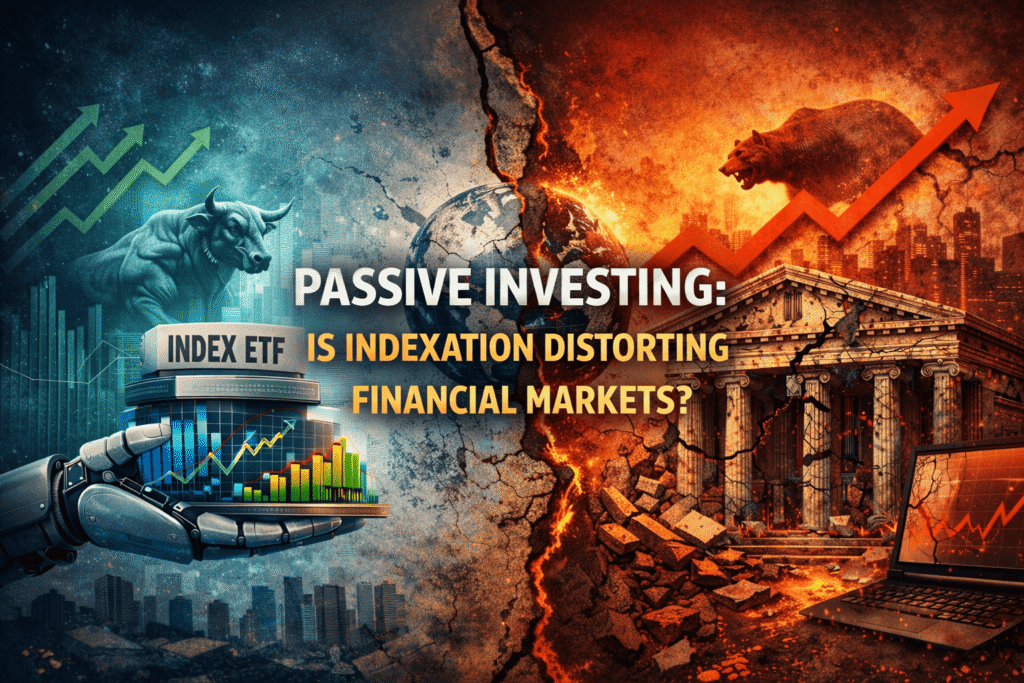
This article examines whether the rise of indexation is merely changing how investors access markets or whether it is quietly distorting the markets themselves. By analyzing the growth of passive investing, its impact on price discovery, concentration, and volatility, and its broader systemic implications, the goal is not to challenge the usefulness of index funds, but to assess the unintended consequences of their dominance in modern financial markets.
I. The Rise of Passive Investing: From Niche Strategy to Market Dominance
1.1 What Is Passive Investing and Why Did It Win?
Passive investing refers to investment strategies designed to replicate the performance of a predefined market index rather than outperform it. The most common forms are index mutual funds and exchange traded funds that track benchmarks such as broad equity indices, sector indices, or fixed income indices. Unlike active managers, passive funds do not attempt to identify mispriced securities, time the market, or adjust portfolios based on macroeconomic expectations. Their objective is simple and explicit: deliver the market return at the lowest possible cost.
The appeal of this approach lies in its simplicity and consistency. Over time, a large body of academic and empirical evidence has shown that the majority of active fund managers underperform their benchmarks after fees. Management fees, transaction costs, and turnover gradually erode returns, making it difficult for active strategies to justify their higher costs on a risk adjusted basis. Passive investing emerged as a rational response to this structural underperformance.
Another key factor behind its success is diversification. By holding a broad basket of securities, index funds significantly reduce idiosyncratic risk. For long term investors such as households, pension funds, and endowments, this diversification offers a smoother return profile and lowers the probability of catastrophic underperformance. Passive investing also removes behavioral biases from the investment process. Decisions are rule based and systematic, reducing the risk of emotional trading during periods of market stress.
In this context, passive investing did not initially present itself as a revolutionary idea, but as a pragmatic solution. It aligned well with the needs of investors seeking long term wealth accumulation rather than short term alpha. What began as a low cost alternative gradually gained credibility as evidence mounted against the average performance of active management.
1.2 The Growth of Index Funds and ETFs
The rise of passive investing cannot be understood without examining its rapid and sustained growth over the past several decades. Early index funds were launched in an environment dominated by stock picking and discretionary portfolio management. At the time, tracking the market was often perceived as settling for mediocrity rather than pursuing excellence.
This perception began to change as index funds demonstrated their ability to outperform the majority of active funds net of fees. As transparency improved and performance data became more accessible, investors increasingly questioned why they should pay higher fees for inferior outcomes. Institutional investors were among the first to respond. Pension funds and sovereign wealth funds, constrained by fiduciary duties and long investment horizons, began allocating larger portions of their portfolios to passive strategies.
The development of ETFs accelerated this shift. ETFs combined the benefits of indexation with intraday liquidity and lower operational constraints. They allowed investors to gain instant exposure to entire markets, sectors, or asset classes with a single trade. This innovation made passive investing accessible not only to institutions but also to retail investors, advisors, and asset allocators.
Scale played a crucial role in reinforcing this growth. As assets under management increased, passive fund providers benefited from economies of scale that further reduced fees. Lower costs attracted more inflows, creating a self reinforcing cycle. Over time, a small number of large asset managers came to dominate the passive investment landscape, managing trillions in indexed assets across global markets.
This expansion was also supported by regulatory and technological factors. Fee disclosure requirements increased cost awareness among investors. Digital platforms and robo advisors promoted model portfolios heavily weighted toward index funds. In many jurisdictions, passive products became the default option for retirement savings, further embedding indexation into the financial system.
1.3 Theoretical Foundations Behind Indexation
The intellectual foundations of passive investing are deeply rooted in financial economics. At the core lies the Efficient Market Hypothesis, which posits that asset prices reflect all available information. Under this framework, consistently outperforming the market through security selection or timing is extremely difficult, if not impossible, once costs are taken into account.
If markets are broadly efficient, the optimal strategy for most investors is not to search for mispricing, but to hold the market portfolio. Passive investing operationalizes this idea by providing exposure to the aggregate market return. From a theoretical standpoint, index funds are not a compromise, but the logical conclusion of modern portfolio theory.
Academic research has repeatedly supported this view. Numerous studies have shown that only a small fraction of active managers generate persistent alpha, and identifying them in advance is highly uncertain. Even when outperformance occurs, it often fails to persist over time. In contrast, passive strategies offer predictable outcomes closely aligned with market performance.
Indexation also fits neatly into asset allocation frameworks. Rather than focusing on individual securities, investors can concentrate on higher level decisions such as equity versus bonds, domestic versus international exposure, or risk tolerance over the investment horizon. Passive funds serve as efficient building blocks within these portfolios.
However, this theoretical elegance relies on an implicit assumption. Markets remain efficient because a sufficient number of participants actively analyze information, trade on fundamentals, and ensure that prices reflect economic reality. Passive investors free ride on this process. As long as they remain a minority, the system functions smoothly. The growing dominance of indexation raises the question of whether this balance can hold when passive strategies become the norm rather than the exception.
This view is strongly supported by the academic literature, most notably in Eugene F. Fama’s foundational work on market efficiency.
By understanding why passive investing emerged, how it scaled so rapidly, and the theory that underpins it, the foundation is set for a more critical examination. The next step is to assess how this shift may be altering the very mechanisms that passive investing depends on.
II. How Indexation May Be Distorting Financial Markets
2.1 Price Discovery Under Pressure
Financial markets rely on price discovery to allocate capital efficiently. Prices are meant to reflect a continuous assessment of information such as earnings expectations, balance sheet strength, competitive positioning, and macroeconomic conditions. This process depends on investors who actively analyze securities and trade based on their conclusions. Passive investing, by design, does not participate in this mechanism. Index funds buy and sell securities based solely on index composition and weighting rules.
As passive assets grow, a larger share of market flows becomes detached from fundamental analysis. When capital enters an index fund, it is automatically distributed across constituent stocks, regardless of valuation or outlook. Similarly, redemptions trigger mechanical selling. This dynamic weakens the informational content of trades and shifts the burden of price discovery onto a shrinking pool of active investors.
The inclusion or exclusion of a stock from a major index illustrates this effect clearly. Companies added to widely tracked indices often experience an immediate rise in demand, while those removed face abrupt selling pressure. These price movements are not driven by changes in fundamentals, but by index mechanics. Over time, repeated flows of this nature may create persistent mispricings, particularly for stocks with large index weights.
The risk is not that price discovery disappears entirely, but that it becomes less robust. With fewer investors assessing value, prices may adjust more slowly to new information. In such an environment, markets can remain liquid and efficient under normal conditions, yet become more fragile when shocks occur.
This weakening of traditional price signals echoes broader concerns around market transparency, which have already emerged with the growth of dark pools and off exchange trading.
2.2 Concentration Risk and Market Power
One of the most visible consequences of indexation is the growing concentration of capital in a small number of large companies. Most major indices are weighted by market capitalization, which naturally directs more capital toward the largest firms. As passive inflows increase, these firms attract disproportionate investment, reinforcing their dominance within indices and portfolios.
This creates a feedback loop. Rising market capitalization increases index weight, which attracts more passive inflows, further boosting prices. Over time, this dynamic can lead to stretched valuations at the top of the market and a widening gap between index heavyweights and smaller companies. The result is a market structure increasingly driven by size rather than economic fundamentals.
Concentration is not limited to companies. It also extends to asset managers. A small number of large passive fund providers now hold significant ownership stakes in a wide range of publicly listed firms. This level of common ownership raises questions about competition, corporate governance, and accountability. When the same investors hold substantial stakes across competing companies within an industry, incentives may shift away from aggressive competition toward stability and index preservation.
Concerns about common ownership and the growing influence of a small number of passive managers have been clearly articulated in The Problem of Twelve published by Harvard Law School.
Voting power further amplifies this influence. Passive managers are often among the largest shareholders in public companies, giving them significant say in governance matters. Yet their business model does not depend on firm level performance relative to peers. This raises concerns about whether passive ownership can effectively discipline management or whether it contributes to a more complacent corporate environment.
2.3 Volatility, Liquidity, and Market Stress
Passive investing is often associated with stability, as index funds typically have long term investment horizons and low turnover. Under normal market conditions, this perception is largely justified. However, during periods of stress, the mechanics of indexation can amplify volatility rather than dampen it.
Large scale inflows and outflows from passive vehicles occur at the fund level, not the security level. When investors redeem shares of an index fund or ETF, the fund must sell its underlying holdings in proportion to index weights. This can lead to synchronized selling across large segments of the market, even when the underlying fundamentals of individual companies differ significantly.
Liquidity mismatches also pose a risk. Some ETFs offer intraday liquidity while holding underlying assets that may be less liquid, particularly in fixed income or niche equity segments. In calm markets, this structure functions smoothly. In stressed environments, it can lead to dislocations between ETF prices and the value of their underlying assets, exacerbating market volatility.
Moreover, passive flows tend to be procyclical. In rising markets, inflows reinforce upward momentum, while in downturns, outflows accelerate declines. This herd like behavior does not originate from passive strategies themselves, but from investor behavior interacting with passive structures. The result is a market that can appear stable for extended periods, yet react sharply when sentiment shifts.
Taken together, these dynamics suggest that indexation may be altering how markets respond to information and stress. The concern is not that passive investing inevitably destabilizes markets, but that its growing dominance changes the nature of market risk. Understanding these distortions is essential before drawing conclusions about whether the benefits of indexation continue to outweigh its systemic costs.
III. Systemic Implications and the Future of Passive Investing
3.1 Passive Investing and Financial Stability
As passive investing becomes a dominant force, its implications extend beyond individual portfolios to the stability of the financial system itself. The central concern is not the existence of passive strategies, but their scale. When a large share of market activity is driven by rule based allocation rather than discretionary judgment, the system may become more vulnerable to correlated behavior.
One potential risk lies in the uniformity of reactions to market events. Passive funds track similar benchmarks and follow comparable rebalancing rules. In periods of market stress, this homogeneity can lead to synchronized selling across asset classes and geographies. Unlike active managers, passive funds cannot selectively reduce exposure to specific risks. Their mandate requires them to remain invested according to index composition, even when market conditions deteriorate rapidly.
Stress episodes have so far been absorbed without systemic failure, but they have revealed areas of fragility. Sharp market declines have shown how quickly liquidity can evaporate when many investors attempt to exit similar positions simultaneously. While passive vehicles themselves are not the root cause of panic, their structure can transmit and amplify shocks across the financial system.
Regulators have increasingly focused on these dynamics. Concerns around liquidity, market concentration, and common ownership have prompted closer scrutiny of large passive asset managers. The challenge for policymakers is to address potential systemic risks without undermining the efficiency and accessibility that passive investing has brought to markets.
3.2 Active Management’s Changing Role
The growth of indexation has reshaped the role of active investors rather than eliminating it. In theory, passive investing depends on active management to function properly. Price discovery, risk assessment, and capital allocation require participants willing to analyze information and trade based on conviction. As passive assets grow, the relative importance of active investors increases, even as their share of assets declines.
This paradox suggests a potential equilibrium. If passive investing becomes too dominant, mispricings may increase, creating greater opportunities for active managers. These opportunities can attract capital back into active strategies, restoring balance. In this sense, the relationship between passive and active investing is not zero sum, but interdependent.
However, this adjustment may not occur smoothly. Active management is becoming more concentrated in specialized strategies, such as hedge funds, private markets, and high conviction portfolios. Traditional long only active funds face pressure from both sides, squeezed by lower cost passive alternatives and higher performance expectations. The result is a smaller but more influential group of investors responsible for setting prices.
For markets, this raises an important question. Can a reduced number of active participants maintain efficient pricing across increasingly complex and globalized markets? The answer depends on whether incentives remain sufficient for skilled capital allocators to engage in the costly process of fundamental analysis.
3.3 Can Indexation Be Reformed Rather Than Replaced?
The debate around passive investing is often framed as a binary choice between active and passive strategies. In reality, the future is more likely to involve adaptation rather than reversal. Several developments suggest that indexation itself may evolve to address some of its limitations.
One such development is the rise of alternative indexing approaches. Factor based strategies and rules driven portfolios attempt to capture systematic sources of return while retaining some sensitivity to valuation, risk, or quality. These approaches blur the line between active and passive, offering a more nuanced form of indexation.
Corporate governance is another area of focus. As large passive managers hold significant voting power, calls for greater transparency and accountability have intensified. Enhancing stewardship practices and aligning voting behavior with long term value creation could mitigate concerns about passive ownership diluting corporate discipline.
Finally, regulatory frameworks may adapt to reflect the systemic importance of large passive investors. This could include stress testing, enhanced disclosure requirements, or oversight tailored to the scale and influence of indexed assets. The objective would not be to restrict passive investing, but to ensure that its benefits do not come at the expense of market resilience.
The future of passive investing is unlikely to be a simple continuation of past trends. Indexation has delivered undeniable benefits to investors, but its dominance raises legitimate questions about market structure and stability. The challenge ahead is to preserve the efficiency and accessibility of passive strategies while ensuring that financial markets remain capable of discovering prices, allocating capital, and absorbing shocks in an increasingly indexed world.
Conclusion
Passive investing has reshaped modern financial markets more profoundly than almost any innovation of the past half century. What began as a low cost, rational alternative to active management has evolved into a dominant force guiding how capital is allocated across the global economy. For individual investors, the benefits are clear. Index funds have democratized access to markets, reduced fees, and delivered reliable long term returns that most active strategies have failed to match.
At the market level, however, the picture is more nuanced. As indexation grows, a rising share of investment decisions becomes mechanical, detached from fundamentals, and concentrated in the largest companies and indices. Price discovery increasingly relies on a shrinking pool of active investors, while passive flows amplify concentration, procyclicality, and common ownership. These dynamics do not imply that markets are broken, but they do suggest that the structure underpinning them is changing in meaningful ways.
The central issue is therefore not whether passive investing is good or bad, but whether its current trajectory is sustainable. Financial markets function best when incentives are balanced, when prices reflect information, and when capital can adjust flexibly to changing conditions. Passive strategies depend on this ecosystem, even as their growth places strain on it. Left unchecked, excessive reliance on indexation could weaken the very mechanisms that make passive investing effective.
Looking ahead, the most plausible outcome is not a reversal of passive investing, but an evolution of it. A renewed role for active management, improvements in governance and stewardship, and thoughtful regulatory oversight can help preserve market efficiency while retaining the advantages of indexation. Passive investing is not distorting markets by default, but its dominance demands careful attention.
In that sense, indexation represents both a success and a test for modern finance. It has solved the problem of investor underperformance, yet it now challenges the market’s ability to function without continuous human judgment. How investors, asset managers, and regulators respond to this tension will shape the next phase of financial markets.