Table of contents
ToggleIntroduction
Africa is on track to become the demographic center of gravity of the global economy. Over the next three decades, the continent will account for more than half of global population growth, while Europe, China and Japan continue to age and, in some cases, shrink. By 2050, one in four people on Earth will be African. Yet despite this extraordinary demographic momentum, Africa today represents less than 4 percent of global GDP and attracts only a small share of global capital flows. This striking imbalance lies at the heart of Africa’s economic paradox.
In theory, such demographic dynamics should position Africa as a future engine of global growth. A young and expanding workforce can fuel productivity gains, domestic consumption and industrial expansion. History offers compelling precedents. East Asia’s economic rise was underpinned by a favorable demographic structure combined with massive investments in infrastructure and capital accumulation. Africa, however, has so far struggled to translate population growth into sustained economic convergence with advanced economies.
The reason is not a lack of opportunity, but a misalignment between potential and structure. Rapid population growth has outpaced job creation, education systems and urban planning. Large segments of the workforce remain trapped in low-productivity activities, while unemployment and informality persist among younger cohorts. At the same time, chronic underinvestment in energy, transport and logistics continues to raise the cost of doing business, limiting industrialization and regional integration.
Capital constraints further compound these challenges. Domestic financial systems remain shallow, long-term financing is scarce, and foreign investors often perceive African markets as high-risk environments due to political uncertainty, currency volatility and regulatory fragmentation. As a result, many projects that are economically viable in theory struggle to reach financial close in practice. The gap between savings, investment needs and available capital remains wide.
Yet focusing solely on constraints risks missing the broader picture. Across the continent, digital technologies, fintech solutions and new investment models are beginning to reshape economic activity. Mobile payments, digital public infrastructure and private capital initiatives are demonstrating Africa’s ability to leapfrog traditional development pathways. These developments suggest that Africa’s economic future is not predetermined, but contingent on how effectively demographic momentum is combined with infrastructure development and capital mobilization.
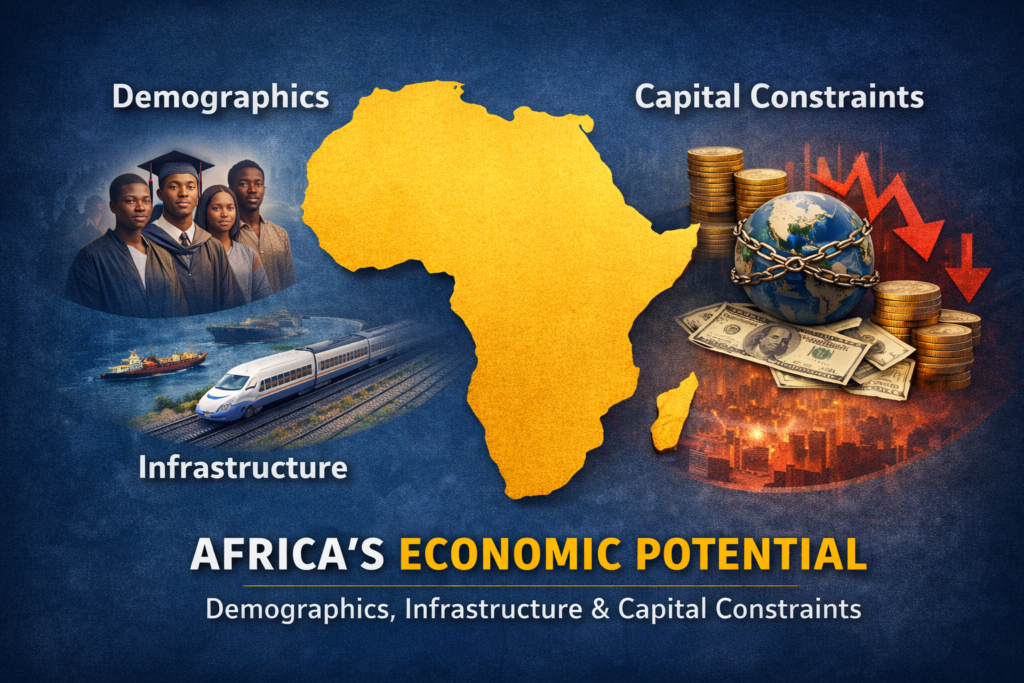
This article explores Africa’s economic potential through three interconnected lenses: demographics, infrastructure and capital. It argues that while Africa’s population dynamics offer a powerful foundation for growth, they can only translate into long-term prosperity if supported by large-scale infrastructure investment and deeper, more resilient capital markets. Understanding this interaction is essential for investors, policymakers and businesses seeking to engage with Africa’s next phase of economic transformation.
I. Demographics as a Growth Engine and a Structural Challenge
Africa’s demographic trajectory is unlike that of any other region in the world. While most advanced economies are grappling with aging populations, shrinking workforces and rising dependency ratios, Africa is entering a prolonged phase of demographic expansion. This dynamic is often presented as the continent’s greatest asset. Yet demographics alone do not generate growth. They amplify existing structures, whether productive or fragile. In Africa’s case, population growth simultaneously represents a powerful engine for future development and a source of deep structural pressure.
While Africa faces the challenge of absorbing a rapidly growing population, many advanced economies are struggling with the opposite problem. As explored in our analysis on aging societies and inflation dynamics, demographic trends are becoming one of the most powerful forces shaping global macroeconomic outcomes.
1.1 Africa’s Demographic Explosion: Scale, Speed and Global Implications
Africa is the fastest-growing region in demographic terms. Its population, estimated at around 1.4 billion today, is projected to double by 2050. This growth is not evenly distributed. A handful of countries such as Nigeria, Ethiopia, the Democratic Republic of Congo and Tanzania will account for a significant share of the increase. At the same time, Africa is the youngest continent globally, with a median age below 20, compared to over 40 in much of Europe and East Asia.
From a macroeconomic perspective, this demographic expansion has profound implications. A growing working-age population can support higher potential growth through three main channels: labor supply, consumption and fiscal sustainability. More workers mean a larger productive base. More households entering the middle-income bracket can fuel domestic demand. A favorable dependency ratio can ease pressure on public finances, at least temporarily.
However, the speed of Africa’s population growth also creates unique challenges. Unlike East Asia during its demographic transition, Africa is urbanizing rapidly without industrializing at the same pace. Cities are expanding faster than infrastructure, housing and public services can adapt. The result is often informal urbanization rather than productivity-enhancing agglomeration. In this context, population growth does not automatically translate into higher output per capita.
Globally, Africa’s demographic rise is reshaping long-term economic balances. As labor forces in advanced economies shrink, Africa represents one of the few regions capable of sustaining global labor supply growth. This has implications for migration, global value chains and long-term consumption patterns. Yet whether Africa becomes a driver of global growth or a source of instability depends on how effectively this demographic momentum is managed.
1.2 Human Capital, Education and the Employment Gap
The link between demographics and growth ultimately runs through human capital. A large population is only an asset if it is educated, healthy and productively employed. This is where Africa’s demographic story becomes more complex.
Education access has improved significantly over the past two decades, particularly at the primary level. Enrollment rates have risen, literacy has increased and gender gaps have narrowed in many countries. Yet education quality remains uneven, and secondary and tertiary education systems often fail to equip students with skills aligned to labor market needs. The result is a growing mismatch between education outcomes and employment opportunities.
Youth unemployment and underemployment are among the most pressing economic challenges facing the continent. Each year, millions of young Africans enter the labor market, but formal job creation lags far behind. Most employment remains concentrated in agriculture and the informal sector, where productivity and income growth are limited. This creates a structural employment gap that undermines the potential demographic dividend.
Several structural factors explain this dynamic. Industrialization has been slower and more fragmented than in previous development success stories. Manufacturing sectors remain relatively small, while services growth is often concentrated in low-productivity activities. At the same time, capital-intensive sectors generate limited employment relative to the size of the labor force.
Some governments and private actors are increasingly focusing on vocational training, digital skills and entrepreneurship as partial solutions. Technology-enabled education platforms, coding academies and vocational programs linked to local industries are expanding. While these initiatives are promising, they remain insufficient in scale to absorb the demographic wave on their own.
The risk is that a prolonged mismatch between demographic growth and employment creation could generate social and political strain. A young population with limited economic opportunities can become a source of instability rather than growth. Managing this transition is therefore not only an economic imperative but also a political one.
1.3 The Rise of Africa’s Consumer Class
Despite these challenges, Africa’s demographic expansion is already reshaping its internal markets. One of the most visible effects is the gradual rise of a consumer class driven by urbanization, income growth and technological adoption.
Africa’s middle class remains smaller and more fragile than in advanced economies, but it is expanding. Urban households with access to stable incomes are increasing their consumption of goods and services beyond basic necessities. This shift is supporting growth in sectors such as telecommunications, financial services, fast-moving consumer goods and housing.
Technology plays a critical role in this transformation. Mobile phone penetration has expanded rapidly, enabling millions of Africans to access financial services for the first time. Mobile payments, digital lending and online marketplaces are lowering transaction costs and integrating previously excluded populations into the formal economy. In many cases, Africa has leapfrogged traditional development stages by adopting digital solutions in the absence of legacy infrastructure.
This emerging consumer base has important implications for investors and businesses. Growth in domestic demand reduces reliance on external markets and commodities, making economies more resilient to global shocks. It also creates opportunities for scalable business models tailored to local conditions, particularly in fintech, e-commerce and digital services.
However, the rise of the consumer class remains uneven across countries and income segments. Income volatility, limited social protection and exposure to inflation can quickly reverse gains. Demographics can support consumption growth, but only if accompanied by productivity gains and stable macroeconomic conditions.
In sum, Africa’s demographic dynamics are neither a guarantee of success nor a sentence to stagnation. They magnify existing strengths and weaknesses. A young and growing population offers an unprecedented opportunity for long-term growth, but it also raises the stakes. Whether Africa captures a demographic dividend or faces a demographic burden depends on its ability to invest in human capital, create productive employment and build the infrastructure and capital base needed to support a rapidly expanding society.
II. Infrastructure Deficit: The Backbone of Africa’s Growth Bottleneck
If demographics define Africa’s long-term potential, infrastructure determines how much of that potential can realistically be unlocked. Across the continent, deficiencies in energy, transport and logistics represent one of the most binding constraints on economic growth. Infrastructure is not merely a supporting factor. It shapes productivity, competitiveness, regional integration and the ability of economies to attract capital. In Africa, chronic underinvestment has turned infrastructure into a structural bottleneck that amplifies demographic and capital constraints.
2.1 Energy, Transport and Logistics: The Cost of Underinvestment
Energy access remains one of the most critical constraints facing African economies. Hundreds of millions of people still lack reliable access to electricity, while those connected to the grid often face frequent outages and high costs. For businesses, unreliable power translates into higher operating expenses, reduced capacity utilization and lower investment incentives. Many firms are forced to rely on costly diesel generators, undermining competitiveness and environmental sustainability.
Transport infrastructure presents a similar challenge. Road and rail networks are often insufficient, poorly maintained or disconnected across borders. Moving goods within and between African countries is expensive and time-consuming compared to other regions. As a result, intra-African trade remains limited, despite the continent’s growing market size. High logistics costs erode the advantages of low labor costs and discourage participation in regional and global value chain.
Ports and logistics hubs further illustrate the scale of the problem. Congestion, limited capacity and inefficient customs procedures increase trade costs and reduce export competitiveness. For landlocked countries, dependence on neighboring transit infrastructure adds an additional layer of vulnerability. These structural frictions raise the cost of industrialization and make diversification away from commodities more difficult.
According to estimates by the African Development Bank, Africa’s annual financing gap to accelerate structural transformation and close its infrastructure deficit is over $400 billion per year, and current efforts would cover only part of that amount, highlighting the scale of investment needed for growth
The macroeconomic consequences are significant. Infrastructure gaps act as a tax on growth, reducing productivity across sectors. They also reinforce spatial inequalities, as regions with better connectivity attract investment while others remain isolated. Over time, underinvestment in infrastructure constrains not only economic output but also fiscal capacity, as weaker growth limits public revenue.
According to data from the World Bank, Africa’s annual infrastructure financing needs far exceed current investment levels, particularly in energy and transport. This persistent gap underscores why infrastructure remains central to any credible growth strategy for the continent.
2.2 Digital Infrastructure and Technological Leapfrogging
While physical infrastructure deficits remain severe, Africa’s experience with digital infrastructure offers a more nuanced picture. Mobile networks have expanded rapidly, and mobile phone penetration is among the fastest-growing in the world. In many countries, digital connectivity has advanced more quickly than traditional infrastructure, creating opportunities for technological leapfrogging.
Digital infrastructure has enabled the rise of innovative business models, particularly in financial services. Mobile payments and digital wallets have transformed how individuals and small businesses transact, save and access credit. These technologies have reduced reliance on cash, increased financial inclusion and supported the growth of informal enterprises. In some cases, digital platforms have partially compensated for gaps in banking, transport and retail infrastructure.
Beyond fintech, digital connectivity is supporting growth in e-commerce, online education and digital health services. These sectors are helping bridge geographic and institutional gaps, particularly in underserved areas. For governments, digital public infrastructure such as digital identification systems and e-government platforms can improve service delivery and tax collection.
However, digital leapfrogging has its limits. Reliable electricity, data centers and broadband connectivity remain prerequisites for scaling digital services. Rural and low-income areas often lag behind in access and affordability. Moreover, digital infrastructure cannot fully substitute for physical infrastructure in manufacturing, logistics or heavy industry. Technology can mitigate constraints, but it cannot eliminate them.
The challenge is therefore not to choose between digital and physical infrastructure, but to integrate the two. Digital solutions are most effective when built on a foundation of reliable energy, transport and logistics. Without this base, the productivity gains from technology remain constrained.
2.3 Financing Infrastructure: Public Limits and Private Hesitations
The scale of Africa’s infrastructure deficit raises a fundamental question: how can it be financed. Public investment has traditionally played a central role, but fiscal space across the continent is increasingly constrained. Rising public debt, limited tax bases and exposure to external shocks have reduced governments’ ability to fund large-scale infrastructure projects on their own.
Development finance institutions have stepped in to fill part of the gap, providing concessional loans, guarantees and technical assistance. While these institutions play a crucial role, their resources are insufficient relative to Africa’s needs. Moreover, project preparation and execution often face delays due to regulatory complexity, governance challenges and capacity constraints.
Private capital could theoretically bridge much of the financing gap, but investor participation remains limited. Infrastructure projects in Africa are often perceived as high-risk due to political uncertainty, regulatory changes, currency volatility and long payback periods. These risks increase required returns, making projects financially unviable without public support.
To address this mismatch, blended finance models and public private partnerships are increasingly promoted. By combining public funds, development finance and private capital, these structures aim to reduce risk and crowd in investment. When well designed, they can mobilize significant resources and improve project discipline. When poorly structured, they can create contingent liabilities and fiscal risks.
Ultimately, infrastructure financing is not only a question of capital availability but also of institutional quality. Transparent regulation, predictable policy frameworks and effective project governance are essential to attract long-term investors. Without these foundations, even abundant capital will remain on the sidelines.
Africa’s infrastructure deficit sits at the intersection of demographics and capital constraints. It limits the productivity of a growing population and raises the cost of investment across the economy. Addressing it is therefore not a sectoral challenge but a systemic one. Infrastructure is the backbone of growth, and without a sustained effort to close the gap, Africa’s economic potential will remain largely unrealized.
III. Capital Constraints: The Missing Link Between Potential and Growth
If demographics define Africa’s potential and infrastructure shapes its productive capacity, capital determines the speed and scale at which growth can occur. Across the continent, limited access to long-term, affordable financing remains one of the most persistent obstacles to economic transformation. Capital constraints do not merely slow growth. They distort it, favoring short-term activities over long-term investment and reinforcing structural vulnerabilities. Understanding Africa’s capital gap is therefore essential to understanding why potential has yet to translate into sustained convergence.
3.1 Domestic Capital Markets and Financial System Depth
Africa’s domestic financial systems remain relatively shallow compared to those of emerging and advanced economies. Banking sectors dominate financial intermediation, but they are often characterized by high interest rates, short loan maturities and limited risk appetite. This structure is poorly suited to financing long-term investment in infrastructure, manufacturing or innovation.
According to the Africa Capital Markets Report 2025 from the OECD, sovereign bond markets remain shallow and volatile, with high borrowing costs and weak demand, underscoring why long-term capital is scarce and expensive for African issuers.
Several structural factors explain this limitation. Savings rates are low in many countries due to modest income levels and large informal sectors. Pension funds and insurance markets, which typically provide long-term capital, are underdeveloped or concentrated in a few larger economies. As a result, domestic sources of patient capital remain scarce.
Capital markets face similar challenges. Equity markets are often small, illiquid and dominated by a limited number of firms, many of them in financial or extractive sectors. Bond markets, where they exist, tend to focus on short-term sovereign issuance, crowding out private borrowers. Corporate bond markets remain embryonic, limiting firms’ ability to diversify funding sources beyond bank loans.
This lack of financial depth has real economic consequences. Small and medium-sized enterprises struggle to scale, even when demand exists. Infrastructure projects face maturity mismatches between long-term investment needs and short-term financing. Innovation is constrained by limited access to venture capital and growth equity. In this environment, economic activity gravitates toward sectors that require less upfront capital, reinforcing low-productivity equilibria.
3.2 Foreign Capital, Risk Perception and Currency Volatility
Given domestic constraints, foreign capital plays a critical role in financing African economies. Foreign direct investment, portfolio flows and development finance have all contributed to growth over the past decades. Yet foreign capital remains volatile, unevenly distributed and highly sensitive to risk perceptions.
FDI flows tend to concentrate in a narrow set of sectors and countries, particularly natural resources, telecommunications and a few large consumer markets. This concentration limits spillovers to the broader economy and exposes countries to commodity cycles. Portfolio flows, while growing, are often short-term and prone to sudden reversals in response to global financial conditions.
Risk perception is central to this dynamic. Political instability, regulatory uncertainty and governance concerns increase the cost of capital. Currency volatility further amplifies risk, especially for investors whose liabilities are denominated in foreign currency. Exchange rate depreciation can quickly erode returns, discouraging long-term commitments.
Macroeconomic volatility reinforces these constraints. Inflationary pressures, external imbalances and debt sustainability concerns periodically trigger capital outflows and tightening financial conditions. In such environments, governments often face difficult trade-offs between stabilizing the economy and supporting growth-enhancing investment
International institutions have repeatedly highlighted how global monetary tightening disproportionately affects African economies by raising borrowing costs and reducing access to capital. The result is a pro-cyclical financing environment in which capital is most scarce precisely when it is most needed.
3.3 New Capital Pathways: Private Equity, Fintech and South-South Investment
Despite these challenges, Africa’s capital landscape is evolving. New sources of financing and alternative investment models are gradually reshaping how capital is mobilized and allocated across the continent.
Private equity and venture capital have grown significantly over the past decade, particularly in technology, fintech and consumer-oriented sectors. These investors bring not only capital but also managerial expertise, governance standards and access to global networks. While still small relative to global markets, private capital has demonstrated its ability to scale businesses and foster innovation in environments where traditional finance falls short
Fintech is also transforming capital access at the micro and small enterprise level. Digital lending platforms, mobile-based savings products and alternative credit scoring are expanding financial inclusion and reducing transaction costs. While these solutions cannot replace long-term project finance, they improve capital allocation efficiency and support entrepreneurship.
Another notable trend is the rise of South-South investment. Capital flows from China, the Gulf states, India and other emerging economies have become increasingly important. These investors often adopt longer-term horizons and are more willing to engage in infrastructure and industrial projects. Their growing presence is reshaping Africa’s external financing landscape, although it also raises questions about debt sustainability and geopolitical alignment.
Development finance institutions continue to play a catalytic role by de-risking projects, crowding in private capital and supporting institutional reforms. Blended finance structures, when well designed, can help bridge the gap between Africa’s investment needs and investor requirements.
Capital constraints remain the missing link between Africa’s potential and its realized growth. The challenge is not a lack of global capital, but a mismatch between the continent’s risk profile, institutional frameworks and the expectations of long-term investors. Addressing this gap requires deeper domestic financial systems, more stable macroeconomic environments and innovative financing models. Without these elements, Africa’s demographic and economic potential will remain only partially realized.
Conclusion
Africa’s economic future is often described in superlatives, whether optimistic or pessimistic. The reality is more nuanced. The continent’s long-term potential is undeniable, driven by demographic momentum unmatched anywhere else in the world. Yet this potential is neither automatic nor guaranteed. Demographics, infrastructure and capital do not operate in isolation. They reinforce each other, for better or for worse.
A young and rapidly growing population can be a powerful engine of growth, but only if it is productively employed and supported by adequate human capital. Without sufficient jobs, education and skills development, demographic momentum risks becoming a source of social and economic strain rather than prosperity. Africa’s demographic trajectory raises the stakes, amplifying both opportunities and vulnerabilities.
Infrastructure sits at the center of this equation. Energy, transport, logistics and digital networks determine whether labor becomes productive, whether firms can scale and whether markets can integrate. Persistent underinvestment has turned infrastructure into one of the most binding constraints on growth, raising costs across the economy and limiting industrialization. While digital technologies offer important opportunities for leapfrogging, they cannot fully substitute for physical infrastructure. Sustainable growth requires both.
Capital constraints remain the critical missing link. Africa’s economies face a paradox of abundant global capital and limited access to long-term financing. Shallow domestic financial systems, volatile foreign capital flows and high risk premiums restrict investment precisely where it is most needed. Emerging alternatives, from private equity to fintech and South-South investment, offer promising pathways, but they are not yet sufficient in scale to close the gap on their own.
The interaction between these three forces will shape Africa’s trajectory over the coming decades. In one scenario, continued infrastructure deficits and capital scarcity could prevent demographic growth from translating into higher living standards, reinforcing inequality and instability. In another, targeted investment, institutional reform and deeper capital markets could unlock a virtuous cycle of productivity, consumption and innovation.
For policymakers, the challenge lies in creating credible frameworks that attract long-term capital while investing in human and physical foundations. For investors, Africa demands patience, local understanding and a willingness to engage beyond short-term cycles. For the global economy, the stakes are high. As traditional growth engines slow, Africa’s success or failure will increasingly influence global growth, migration and stability.
Africa’s economic potential is real, but potential alone does not drive development. Converting it into sustained growth will depend on deliberate choices, coordinated investment and the ability to align demographics, infrastructure and capital into a coherent development strategy.